Anyone who performs a repeating manual task and wants to understand its impact on their time, such as freelancers, managers, or individuals looking to optimize their routines.
Como funciona
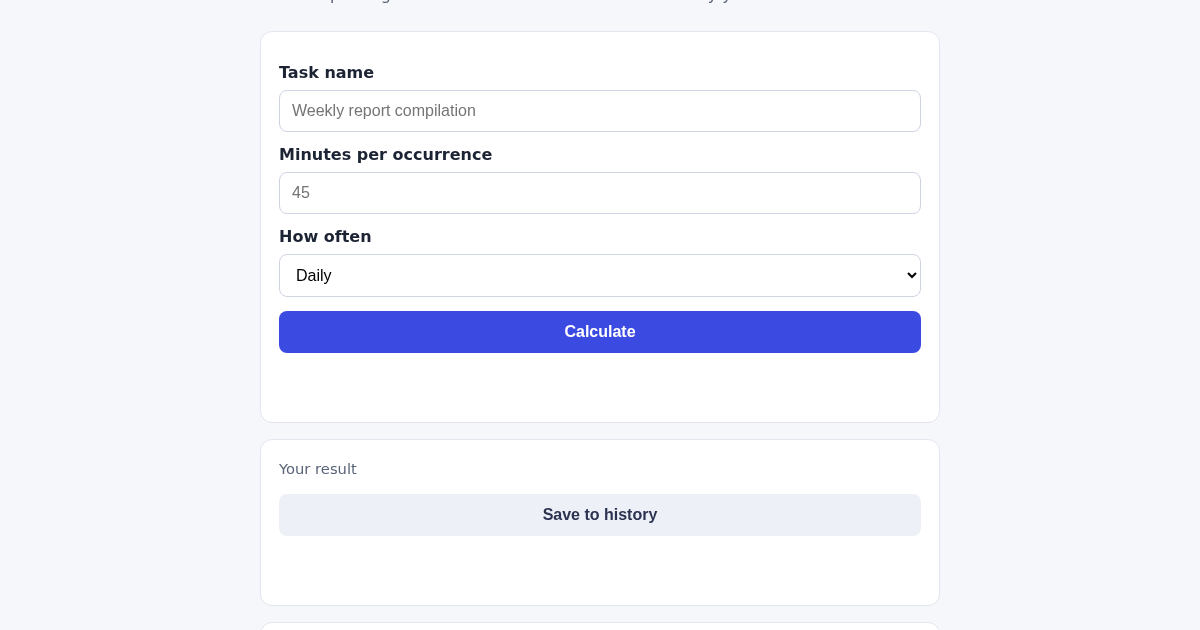
- Enter the task name, the minutes it takes per occurrence, and how often it repeats (e.g., daily, weekly, monthly).
- The app calculates the total hours and working days lost per year based on your inputs.
- A result card displays the headline number and the breakdown, which you can share or download.
- Your calculation is saved to a history list, and you can export the result as a text or JSON file.
O que você ganha
- Reveals the hidden yearly cost of repetitive tasks
- Helps prioritize which tasks to automate or delegate
- Provides a shareable result to justify process changes
- Saves calculation history for easy reference
- Exports results in text or JSON for further use
Captura de tela
Como configurar e usar
- Open the calculator page.
- Enter the task name, minutes per occurrence, and how often it repeats.
- Click Calculate.
- See the yearly hours and working days lost on the result card.
- Save or download the result.
Perguntas frequentes
Is my data stored?
Your calculations are saved in a JSON file on the server for your own history. No personal data is collected.
What exactly does this calculator do?
It multiplies the minutes per occurrence by the number of occurrences per year to show total hours and working days lost. It does not track actual time or integrate with other tools.
Produtos relacionados
HealthClean: Health Data Export Cleaner for Wearables
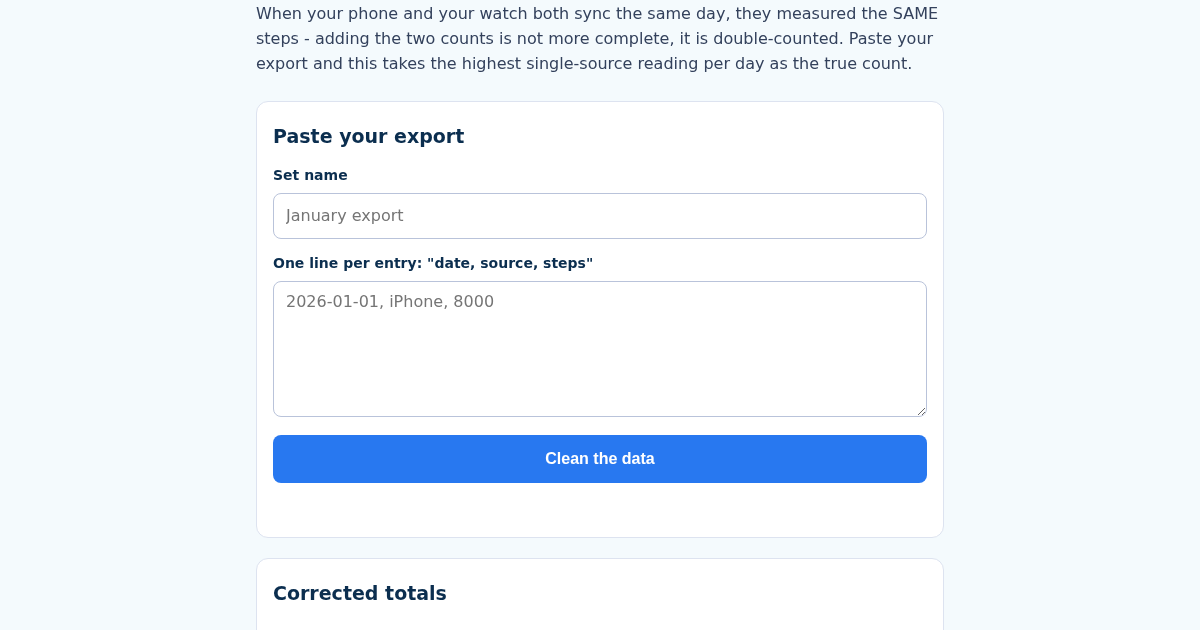
When your phone and your watch both sync the same day's walk, most people's instinct - and some naive export tools - just add the two step counts together. That is not a more complete number, it is double-counted: both…
HealthClean: Health Data Export Cleaner for Wearables
When your phone and your watch both sync the same day's walk, most people's instinct - and some naive export tools - just add the two step counts together. That is not a more complete number, it is double-counted: both…
The Average Says You're Fine
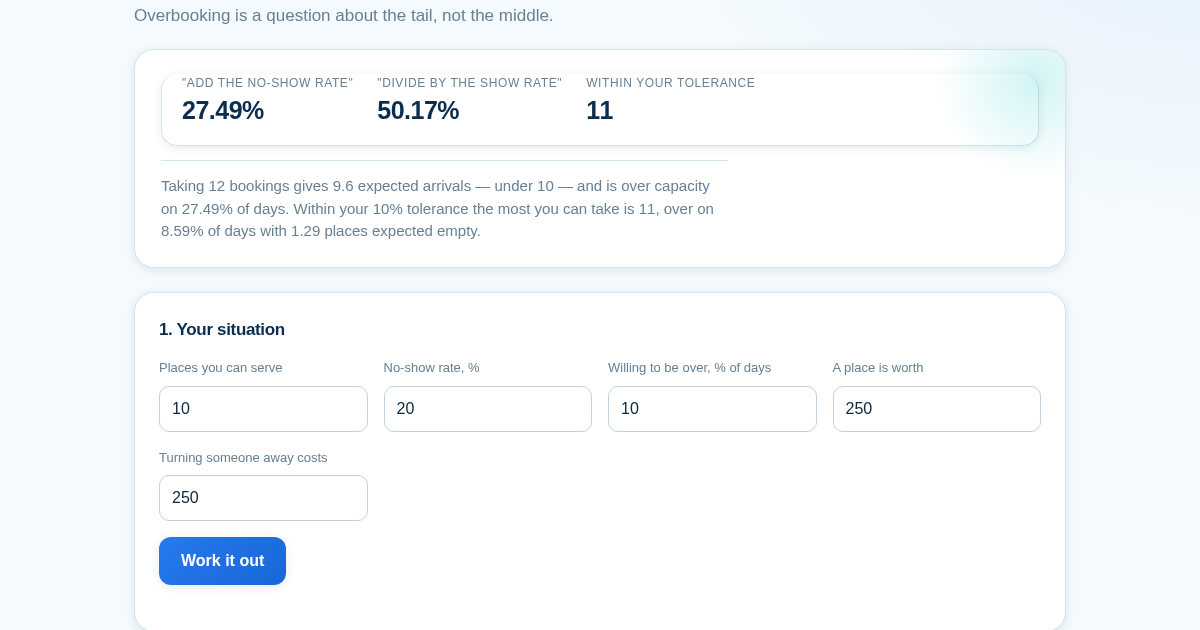
Ten places, one in five does not turn up, so take twelve bookings — the average says 9.6 arrive and 9.6 is under ten. That is exactly right, and it is the wrong number to look at: twelve bookings is over capacity on…
Stopping at Significance Isn't a 5% Test
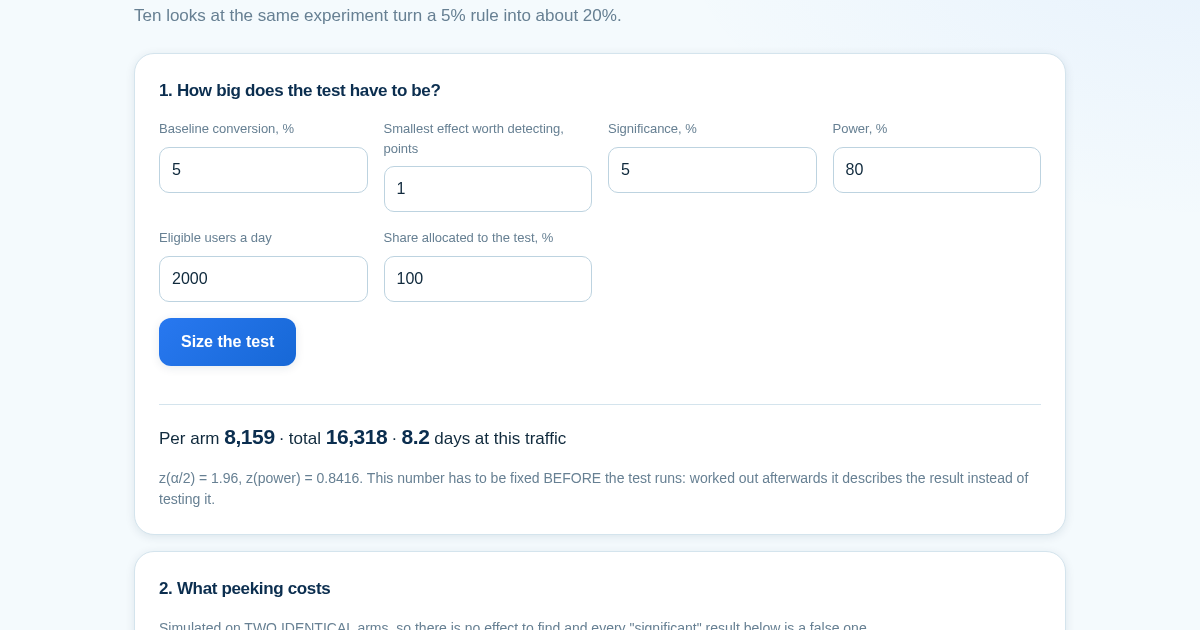
Checking a test once gives roughly the 5% false-positive rate you asked for. Checking ten times along the way and stopping at the first crossing gives about 20%, and twenty times gives about 24% - simulated here on two…